
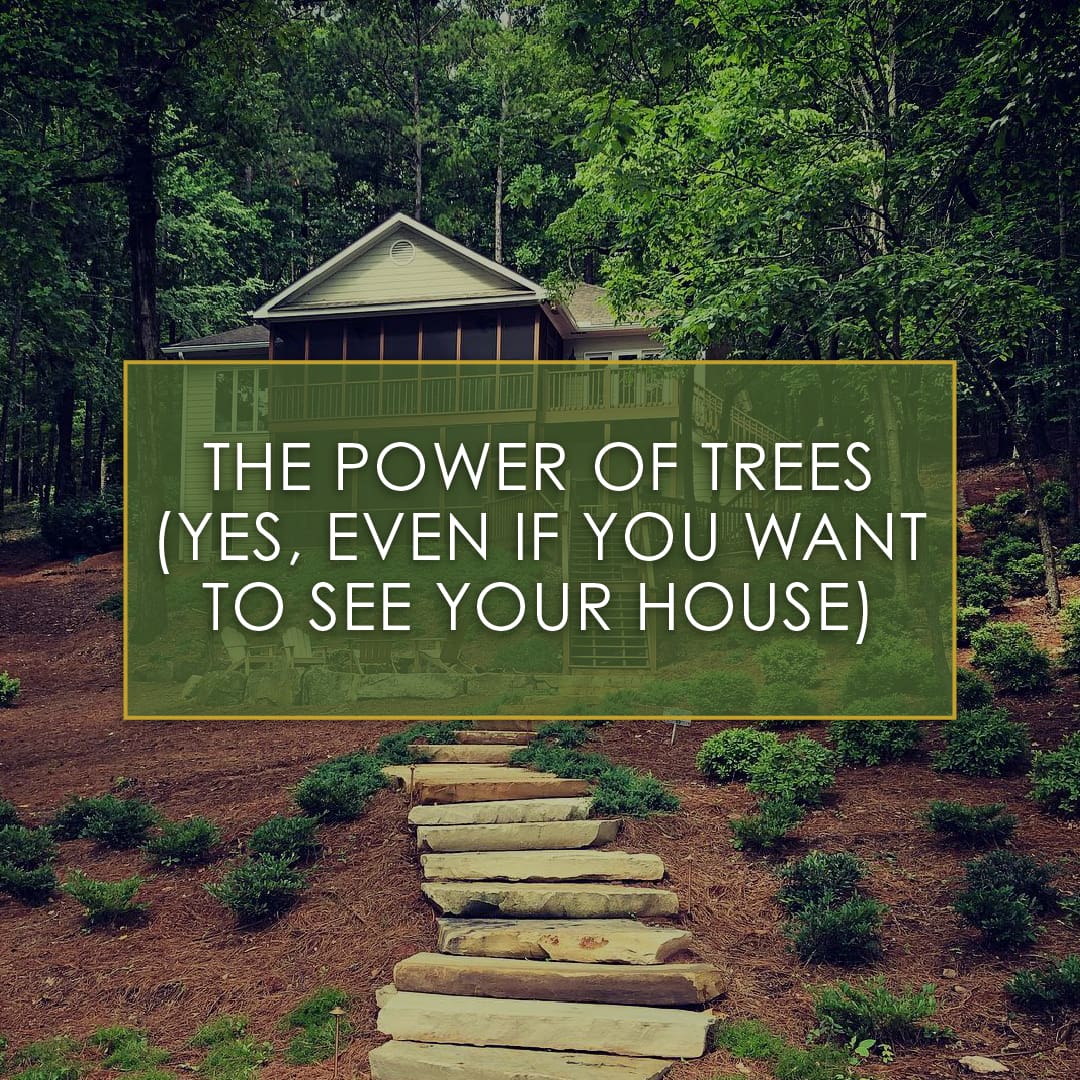
Some of the most beautiful places in the South have something in common:
You don’t see the buildings all at once.
In older neighborhoods throughout Atlanta, Charleston, and Savannah, the architecture is woven into a mature tree canopy.
Trees soften the edges. They frame views. They give buildings a sense of permanence.
The homes feel grounded – like they belong exactly where they are.
And that’s the key:
It’s not just the architecture.
It’s not just the landscape.
It’s the combination that creates the feeling.
Why Trees Make Architecture Better
Trees don’t hide good architecture.
They reveal it.
In thoughtful landscape design, trees:
- Create foreground and background
- Soften scale
- Help a home feel anchored instead of exposed
A well-placed tree can make a house feel more balanced, more proportional, and more inviting than a fully open view ever could.
There’s a difference between seeing a house and experiencing it.
The best homes aren’t displayed all at once – they’re approached, framed, and discovered.
The “I Want to See My House” Instinct
We hear this all the time – and it’s completely understandable.
You’ve invested in your home. You want it to feel open, safe, and visible.
Wanting to see your house isn’t wrong.
But it’s usually pointing to a design issue, not a tree issue.
When a home feels better fully exposed, it’s often because the landscape hasn’t been doing its job yet.
Trees aren’t about blocking views.
They’re about shaping them.
They guide the eye, create depth, and give the architecture something to sit within. Without that context, even beautiful homes can feel unfinished.
Trees, Time, and Property Value
One of the reasons mature neighborhoods feel so compelling is that they can’t be rushed.
Established trees take time.
Canopy takes patience.
And that maturity quietly influences how people perceive property value.
Homes with thoughtful landscaping and strong tree presence tend to feel:
- More complete
- More established
- More desirable over time
You can renovate a house.
You can update finishes.
You can add square footage.
But you can’t fast-forward a tree.
That long-term perspective matters.
How Trees Fit Into Landscape Design
We don’t think of trees as accessories.
We think of them as structure.
In professional landscape design, that means:
- Placement matters more than quantity
- Scale matters more than speed
- Relationship to the home matters more than symmetry
We’re not just thinking about what a tree looks like at installation.
We’re thinking about:
- How it frames the house in 5–10 years
- How it affects shade and temperature
- How it creates enclosure and comfort
The goal isn’t to make the house disappear.
It’s to help it belong.
What Trees Actually Change About a Space
When trees are doing their job well, people don’t talk about the trees.
They talk about how the space feels.
You’ll hear things like:
- “It feels calmer out here.”
- “It’s cooler than I expected.”
- “We’re spending more time outside.”
- “The house just feels right.”
That’s not accidental.
That’s what happens when outdoor space design supports how people actually live.
The Takeaway
Great homes don’t sit in open space.
They’re anchored – by land, by trees, and by time.
If you want a property that feels grounded, welcoming, and complete, trees aren’t something to work around.
They’re a big part of why the whole space works in the first place.